Zambia Travel Information
Background and History of Zambia
Apart from the most spectacular views of the magnificent Victoria Falls, Zambia
has some of Africa`s finest Game Reserves in the world. The wild Zambezi River, breath-taking lakes and wetlands , abundance of birds and wildlife and an overall friendly country is what Zambia has to offer. Holidays are fulfilled with adventure and scenic beauty.
Zambia has one of the lowest population to land ratio’s in Africa. Only 10 million people in a country half the size of Europe. The employment opportunities offered in the post independence era in the copper mines and associated industries led to a strong rural-urban migration. The result making Zambia one of the most urbanised countries in Africa. About one fifth of the population lives on the Copperbelt to the north of the capital, but the biggest concentration of people is in Lusaka itself with an estimated population of over 2 million. This has resulted in massive tracts of uninhabited land across the country.
People and Cultures of Zambia
Zambia’s contemporary culture is a blend of values, material and spiritual traditions of more than 70 ethnically diverse people. Most of the tribes of Zambia moved into the area in a series of migratory waves a few centuries ago. They grew in numbers and many travelled in search of establishing new kingdoms, farming land and pastures. Before the colonial period, the region now known as Zambia was the home of a number of free states. Each having comprehensive economic links with each other and the outside world along trade routes to the east and west coast of Africa. The main exports were copper, ivory and slaves in exchange for textiles, jewellery, salt and hardware.
During the colonial period, the process of industrialisation and urbanisation saw ethnically different people brought together by economic interests. This, as well as the very definite influence of western standards, generated a new culture without conscious effort of politically determined guidelines. Many of the rural inhabitants however, have retained their indigenous and traditional customs and values. After Independence in 1964, the government recognised the role culture was to play in the overall development of a new nation and began to explore the question of a National identity. Institutions to protect and promote Zambia’s culture were created, including the National Heritage Conservation Commission. Private museums were also founded and cultural villages were established to promote the expression of artistic talents.
There are over 73 dialects spoken in Zambia, but the official language is English. All media and business is in English and most Zambians speak it fairly well. Bemba is the next most commonly understood language, followed by Nyanja Tonga, Luvale, Lozi, Mambwe and Tumbuka.
There is freedom of worship in Zambia with over 15 different churches. Christianity is followed by over 60% of the population.
The flag of Zambia was hoisted for the first time at midnight on the 23rd October, 1964, symbolising patriotism and the nation’s natural resources. An eagle in flight over three stripes of red black and orange on a green background. Red represents the struggle for freedom, black, the people of Zambia, orange the country’s mineral wealth and green the wildlife and environment. The eagle in flight symbolises the freedom in Zambia and the ability to rise above national problems.
Geography and Climate
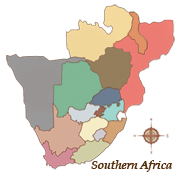
Zambia, a landlocked country in south-central Africa, is about one-tenth larger than Texas. It is surrounded by Angola, Zaire, Tanzania, Malawi, Mozambique, Zimbabwe, Botswana, and Namibia. The country is mostly a plateau that rises to 8,000 ft (2,434 m) in the east.
The Great Rift Valley, which cleaves the earth from the Lower Zambezi River in Southern Zambia to the headwaters of the Nile in Egypt, is now known to be one of the cradles of the human race, and Zambia’s present population lives on lands that have been inhabited by our forebears for almost uncountable aeons. Archaeologists have established that in the northern African Rift Valley, the civilizing process got underway at least 3 million years ago, and crude stone implements, similar to some of that age found in Kenya, have also been found beside the Zambezi river.
Climate
Made up of mild winters and hot summer days. Lightweight casual
clothes can be worn all year round, with a jacket or jersey for early winter
mornings and evenings. On safari keep clothes to a minimum and mostly of neutral
colouring - khakis, browns and greens. A sunhat, sunglasses, sunscreen and insect
repellant are a must.
Economy and Foreign Affairs
Some 85% of Zambians work the country`s relatively infertile soil as subsistence farmers with commercial agriculture mostly confined to a small number of large farms. The leading crops are corn, sorghum, rice, peanuts, sunflower seeds, vegetables, flowers, tobacco, cotton, sugarcane, cassava, and coffee. Cattle, goats, pigs, and poultry are raised. There is also a small fishing industry.
The mining and refining of copper constitutes by far the largest industry in the country and is concentrated in the cities of the Copperbelt. Cobalt, zinc, lead, emeralds, gold, silver, coal, and uranium are also mined. Industries include food and beverage processing, construction, horticulture, and the manufacture of chemicals, textiles, and fertilizer. Most of Zambia`s energy is supplied by hydroelectric plants, especially the one at Kariba Dam.
Copper, cobalt, electricity, tobacco, flowers, and cotton are the main exports. The principal imports are machinery, transportation equipment, petroleum products, electricity, fertilizer, foodstuffs, and clothing. The leading trade partners are South Africa, Switzerland, and Great Britain
Currency
The Zambian currency is the Kwacha and it fluctuates quite regularly. Nobody uses ngwee coins any more as they are worthless. Most used denominations are K500 and K1000, K5000 and K10 000 notes. Travellers cheques, dollars or pounds can be exchanged at any of the many Bureaux de Change in the main Towns. If you are offered an exchange on the black market at the borders, excercise extreme caution as they are notorious for cheating you without you even
realising it ! Travellers cheques attract a commission when changing to other currencies.
Health and Vaccination information
Zambia has very comprehensive Medical Rescue Services. A yellow fever certificate is mandatory if you are travelling from an infected area.
Vaccinations for cholera, tetanus and yellow fever are advised.Malaria is present in the low lying areas of the country which include most of the good wildlife destinations, therefore take the neccessary precaution and prophylactics. There are a number of small clinics in Lusaka which are better than the general hospitals, but the clinics in the rural areas have little more than quinine, aspirin and band aids.
Visa information
A visa is an endorsement on a visa form or in a valid passport of a foreigner granting such person authority to enter Zambia within a specific period upon examination by an Immigration officer at the port of entry.
The period of stay in Zambia shall be determined by an Immigration Officer at the port of entry. The validity of the visa is NOT the period which the holder is entitled to remain in the country but a period within which the holder has to enter Zambia.
THE PREVIOUS VISA FEE WAIVER IS NO LONGER VALID.
Transport and Aiports in Zambia
Zambia can be entered by road from Congo D.R, Zimbabwe, Malawi, Mozambique, Tanzania, Botswana and Namibia. All road borders are open 24 hours a day except for Chembe, Kazungula, Kariba and Chirundu, which are open from 06h00 to 18h00. Victoria Falls Bridge is open untill 20h00.
Zambia has a total road length of 38763kms tarred roads, 8592kms gravel roads and 21999 kms dirt roads. Zambia is notorious for potholes and roadsigns are few but there are major roadworks on some of the main routes at the moment as the roads are gradually being upgraded. Some of the more remote roads require great care and caution while driving. Avoid driving at night if possible as there are no roadmarkings and potholes and animals occur when least expected. A 4x4 is recommended if you’re going anywhere off the main routes. If you’re doing a vehicle trip through Zambia it is a good idea to carry a range of tools and essential spares with you. Many of the villages along the main routes offer tyre mending services at a very reasonable fee.
In Zambia, one drives on the left hand side of the road. The general speed limit on national highways is 100km/h, secondary roads 100km/h and in urban built up areas 65 km/h unless otherwise indicated.
There are many car hire companies in Lusaka and a few in Ndola, offering a small range of vehicles. Some offer a flat weekly rate, but most charge a daily rate plus mileage, insurance and petrol. Most cars come with a chauffeur and are thus expensive
Air Transportation
There are scheduled flights available to Chipata, Kitwe, Livingstone, Mfuwe and Ndola. Zambian Airways flies to Livingstone, Mfuwe (South Luangwa), Victoria Falls and any charter flights Proflight flies to Mfuwe (South Luangwa) and Livingstone and charters.
Airlines serving Zambia are: Zambian Airways, Air Malawi, Air Zaire, Air Zimbabwe, British Airways, Kenya Airways, , South African Airways, Ethiopian Airlines and Regional Air There are frequent services to and from Lusaka and a limited number to Mfuwe International Airport in Luangwa Valley. The Airport is 24kms from the centre of Lusaka.
Various air charter companies will fly to any of the many airstrips around the country and most of the areas worth visiting are accessible by air.
Accommodation Standards
Zambia has a wide range of standards in their accommodation from five star hotels and first class luxury lodges, to rustic bush camps, guesthouses and campsites. Foreigners must pay in hard currency except for the smaller guesthouses. Not all of the small town hotels are equipped to take travellers cheques or credit cards.
Attractions and Wildlife Destinations
- Victoria Falls one of the most spectacular natural wonders of the world attracting thousands of visitors every year. The remarkable Victoria Falls on the Zambezi River, borders both Zambia and Zimbabwe and surrounding area has been declared National Parks and a World Heritage Site - `Mosi-oa-Tunya` - the smoke that thunders. Here there are many adventure activities and facilities offered from helicopter flips to sunse cruises ont the Zambezi to adrenalin water sport.
- Livingstone named after missionary and explorer David Livingstone, the town sprung to life when the spectacular Victoria Falls Bridge, just 10km away the city centre was built. Commissioned by Cecil John Rhodes in 1900, it was completed in 1905 and settlers then moved in to the higher ground at Livingstone to try and escape Malaria. It was the original capital of Zambia (then Northern Rhodesia) in 1911 before it moved to Lusaka in 1935. The main street is lined with classic colonial buildings, typical of the English settler architecture of the time. It`s now a quiet charming town considered the tourism capital of Zambia and has an enormous range of activities available.
- Lake Kariba Found between Zambia and Zimbabwe, this huge man-made lake is one of outstanding beauty. The massive valley which now forms Lake Kariba has survived with most plant and animal species having adapted to the changed conditions. The tiger fish is found in these waters. MAny visitors explore this lake on luxury houseboats.
- The Luangwa Valley runs for 700 km through Zambia`s northeastern sector is the Luangwa Valley, containing an extraordinary and dynamic habitat and a superb wildlife area. The best time to visit for game viewing during the dry season is from June to October, but the rainy season, with its spectacular profusion of greens and reds changes the landscape dramatically and the bird populations increase with the arrival of migrants from the north. The Luangwa is famous for its leopard. There are three National Parks that lie along the Luangwa River`s course, namely the South Luangwa National Park, Luambe National Park and the North Luangwa National Park.
- Kafue National Park, situated in west-central Zambia is the largest park in Zambia and one of the largest in Africa. Kafue spills into three of Zambia`s provinces and has an impressive range bird species and abundant wildlife. The park doesnt have giraffe!
Much of the park is wooded but opens up at intervals to wide grassy clearings known as `dambos`, where antelopes are attracted to the good grazing. These are punctuated with termite mounds, spouting fig trees and phoenix palms. Predators such as leopard and lion are found here. A dominant feature of the park is the Busanga Plains - a vast floodplain fed by the Lufupa River system. This floodplain has been known to recede in the dry season, often trapping hippo in shallow pools.
Short List Preparation
To help you pack and prepare for your Journey here is a Short List to assist you and bringing your attention to the important facts to remember:
- Safety - Petty theft is as common as any major city where unemployment is high. Be very awake when walking around carrying anything of value, there are master pickpockets here and there. Never leave your vehicle unlocked and never change money on the streets. For the most part, however, Zambians are very friendly and helpful.
- Money - Most hotels, restaurants, travel agencies and the bigger shops will take credit cards. Most of the bigger banks will advance local currency against a credit card. Standard Chartered, Stanbic and Barclays Banks have ATM`s which accept Visa cards for cash.
- Tap water in the major towns is purified and perfectly safe to drink. In the more
remote areas always boil it first, except if you’re staying at a lodge or hotel
where drinking water is boiled already. Bottled water is readily available in the
bigger towns. - Communication - There are several Internet Cafes in Livingstone and Lusaka and time on line is very reasonable. A popular one in Lusaka is at the Kilimanjaro Coffee shop at the Manda Hill Shopping Centre with several computers, a hotspot connections and great food!.
- Visiting drivers must hold an International Drivers Licence. Drivers licences from other countries are not valid except SADC countries.
- To bring a vehicle into Zambia one must obtain a temporary import permit (TIP) or, depending on the country of origin of the vehicle, a carnet de passage. If the driver is not the owner of the vehicle, they must have a letter of authorisation from the owner for use of the vehicle in Zambia. Your local AA office should be consulted before leaving for Zambia to check whether any of these conditions have changed.
- Petrol and diesel can be readily obtained in all major towns, but shortages are common in the very remote areas so make sure you have spare fuel for emergencies.
- Local current is 220v, 50 cycle AC
- Zambia is two hours ahead of Greenwich Mean Time, one hour ahead of Central European Time, seven hours ahead of Eastern USA time and ten hours ahead of Western USA time.
- Tipping is discouraged as it is included as service charge on your bill.
Enjoy your travels and exploration of the unspoilt Zambian Country!
Please don't hesitate to contact us directly, we have visited here previously and are able to provide you with up to date information at any time.
^ top
 Compliments